Activating the Common Good
Peter Block
A powerful, inspiring, and achievable vision of a society based on cooperation and community instead of competition and commodification. This book counters the dominant and destructive story that we are polarized, violent, selfish, and destined to consume everything in sight. That is not who we are. The challenge, Peter Block says, is that we are suffering under an economic theology that is based on scarcity, self-interest, competition, and infinite growth. We're told we can purchase and outsource all that matters. Block calls this the business perspective narrative. It dominates not only the economy but also architecture, faith communities, journalism, arts, neighborhoods, and much more. Block offers an antidote: the common good narrative. It embodies the belief that we are basically communal and cooperative. And that we have the capacity to communally produce what we care most about: raising a child, safety, livelihood, health, and a clean and sustainable environment. This book describes how shifts to the common good perspective could transform many areas, fostering journalism that reports on what works, architecture that designs habitable spaces creating connection, faith collectives that build community, a market that is restrained and local, and leadership and activism that build social capital by creating trust among citizens. With these shifts, we would fundamentally change the world we live in for the better.
show more
The Art of Community
Charles H. Vogl
This practical leadership guide offers seven timeless principles for building a supportive and inclusive community with a strong sense of purpose. Many people think of “community” as something that happens by accident or emerges naturally over time. But in The Art of Community, Charles Vogl shows that there are specific principles that leaders can use to create or strengthen communities. Drawing on three thousand years of tradition, Vogl lays out the seven enduring principles that every community of every kind—whether formal or informal—must master to be effective. Vogl describes the purpose of each principle and offers extensive hands-on tools for implementing them. He also shares ways to help communities remain healthy and life-affirming by avoiding toxic rigidity and exclusivity.
show moreBreakthrough Community Change
Paul Born
"Community engagement expert reveals how readers can identify their community's assets and rally people together to achieve collective impact and solve deep-rooted challenges. Many of us are upset by issues like racism, poverty, and climate change, but it takes collective effort to get to the root of these complex problems. Whole Community Change offers a proven methodology for uniting leaders from business, human service organizations, and government to work together with people who have a lived experience of the problem. Readers will learn how to create a community plan, measure impact, and engage everyone in the process. A comprehensive manual, the book also includes sections on topics such as raising money for big change and hosting community conversations. Author Paul Born is president of the Tamarack Institute, whose work has contributed to lower cancer rates in Maine, improved mental health for young people in Florida, and reduced poverty in Iowa and in the entire country of Canada, as described in a April 4, 2019 David Brooks column in the New York Times. This book will provide access to Born's coaching in an accessible and implementable format. People want change, and they want to live in safe and equitable communities. This book helps make that possible"--
show more
Community
Peter Block
This inspiring work explores various ways communities can emerge from the fragmentation that plagues modern society. Block examines a way of thinking that creates an opening for authentic communities to exist, and details what each individual can do to make that happen.
show more
Confessions of an Economic Hit Man
John Perkins
Perkins, a former chief economist at a Boston strategic-consulting firm, confesses he was an "economic hit man" for 10 years, helping U.S. intelligence agencies and multinationals cajole and blackmail foreign leaders into serving U.S. foreign policy and awarding lucrative contracts to American business.
show more
The Courageous Follower
Ira Chaleff
Many significant failures—from FEMA’s response to Hurricane Katrina to the recent economic collapse—could have been prevented or mitigated if those lower in the hierarchy were successful at communicating to leaders the risks they saw in the system. Ira Chaleff’s Courageous Follower model has facilitated healthy upward information flow in organizations for over 15 years. The Harvard Business Review called Chaleff a pioneer in the emerging field of followership—this new edition shares his latest thinking on an increasingly vital topic. The updated third edition of The Courageous Follower includes a new chapter, “The Courage to Speak to the Hierarchy.” Much of Chaleff’s model is based on followers having access to the leader. But today, followers can be handed questionable policies and orders that come from many levels above them—even from the other side of the world. Chaleff explores how they can respond effectively, particularly using the power now available through advances in communications technology. Everyone is a follower at least some of the time. Chaleff strips away the passive connotations of that role and provides tools to help followers effectively partner with leaders. He provides rich guidance to leaders and boards on fostering a climate that encourages courageous followership. The results include increased support for leaders, reduced cynicism and organizations saved from serious missteps. NEW Related Product in February 2010 - The Courageous Follower Self-Assessment: Evaluating Your Followership Style and Growth Path
show more
Decolonizing Wealth
Edgar Villanueva
Decolonizing Wealth is a provocative analysis of the dysfunctional colonial dynamics at play in philanthropy and finance. Award-winning philanthropy executive Edgar Villanueva draws from the traditions from the Native way to prescribe the medicine for restoring balance and healing our divides. Though it seems counterintuitive, the philanthropic industry has evolved to mirror colonial structures and reproduces hierarchy, ultimately doing more harm than good. After 14 years in philanthropy, Edgar Villanueva has seen past the field's glamorous, altruistic façade, and into its shadows: the old boy networks, the savior complexes, and the internalized oppression among the “house slaves,” and those select few people of color who gain access. All these funders reflect and perpetuate the same underlying dynamics that divide Us from Them and the haves from have-nots. In equal measure, he denounces the reproduction of systems of oppression while also advocating for an orientation towards justice to open the floodgates for a rising tide that lifts all boats. In the third and final section, Villanueva offers radical provocations to funders and outlines his Seven Steps for Healing. With great compassion—because the Native way is to bring the oppressor into the circle of healing—Villanueva is able to both diagnose the fatal flaws in philanthropy and provide thoughtful solutions to these systemic imbalances. Decolonizing Wealth is a timely and critical book that preaches for mutually assured liberation in which we are all inter-connected.
show more
The Financial Activist Playbook
Jasmine Rashid
The first and only comprehensive resource designed to empower everyday people with insider knowledge on moving money for a more equitable economy. The money myths end here. We don't need to choose between creating meaningful wealth for ourselves and our families today, or supporting social movements creating a better tomorrow. We don't all need to become certified financial "experts" to be economically empowered and make a real difference in our communities. And we're far from powerless when it comes to changing the financial system, just because we don't happen to belong to the 1%. Quite the opposite. Financial activism is how everyday people radically reimagine money as a tool for widespread well-being, instead of a weapon of absurdly increasing inequality. It's the antidote to traditional finance that evokes confusion, trauma, and (in the best-case scenario) straight-up boredom. It's how we-the underestimated-collectively resist systems that cause harm to people and the planet for the sake of profit, reclaim wealth that's been stolen, and redesign our relationships with capital and one another, in ways big and small. Going beyond tried financial literacy, The Financial Activist Playbook offers eight accessible, actionable, "choose-your-own-adventure" strategies for readers to experiment with. Drawing on timely insider knowledge from the worlds of impact investing, social justice, and more, Rashid illuminates a treasure trove of stories: demonstrating how people power can flow big bucks out of extractive industries, and into the economy of care and abundance we deserve. Playbook readers will be equipped to start visualizing and influencing the unique networks of wealth all around each of us, with strategies like Shifting collective budgets and bank dollars; Flexing our role as everyday philanthropists; Leveraging the magic of community investment; And so much more. Laced with refreshing humor, empowering exercises, and a steadfast commitment to truth-telling, Rashid takes readers on an energizing ride of financial possibility and practicality that will reverberate for generations to come.
show more
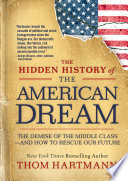
The Hidden History of the American Dream
Thom Hartmann
America's most popular progressive radio host and New York Times bestselling author explores the fall of the American Dream and the steps we can take to bring it back. The widening wealth gap is all too familiar to many Millennials and GenZers, especially when home ownership and the lack of debt seem like faraway fantasies. And it's no surprise when they only hold about 4.6% of the country's wealth while Boomers held 22% at around the same age. So what happened to the promise of the American Dream? In this new, final entry of his celebrated Hidden History Series, Thom Hartmann uncovers the rise of the American middle class through the progressive policies of FDR, through to its downfall with the increasing privatization and economic deregulations of the Reagan era. He also explores potential solutions including: Wealth and inheritance taxes to lessen economic inequality Supporting unions through increasing labor rights Renationalizing public spaces and transportation The American Dream often remains just a dream for many, but this book highlights what needs to be done to take it back and help make it a reality for us all.
show more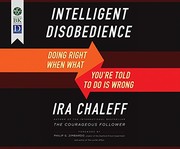
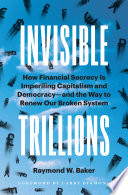
Invisible Trillions
Raymond W. Baker
Essential reading for anyone truly interested in saving democracy from the predations of kleptocracy and plutocracy. -Charles Davidson, The Journal of Democracy This book expands our understanding of the financial secrecy system dominating capitalism today and shows how we can create accountability to restore our democracy. Over the last half century, capitalism has created the means for trillions of dollars, euros, pounds, and other stores of wealth to move invisibly-beyond the control of central bankers, law enforcement agents, and international institutions. With an entire financial secrecy system now dominating capitalist operations, riches flow inexorably upward and accelerate economic inequality. And rising inequality is directly imperiling-weakening, obstructing, and degrading-democracy. This book is not a screed against capitalism-it is a call for capitalism to return to its roots, reenergizing its synergies with democracy. Raymond Baker writes, Democratic capitalism is, in my judgment, the best system yet devised in political economy, but dysfunctions within its capitalist component are undermining the two-part system. Baker explains the tax havens, secrecy jurisdictions, disguised corporations, anonymous trusts, fake foundations, regulatory loopholes, money laundering techniques, and more that make up the financial secrecy system. But he goes beyond the what to the why, examining the motivations driving the system that generates and shelters trillions of dollars that could go toward spreading wealth, generating public goods, and protecting the environment. Going deeper, Baker illustrates how these realities further corrode the commonwealth, with chapters devoted to the facilitating activities and impacts of banks, corporations, enabling lawyers and accountants, governments, and international institutions and concluding with the limiting role played in policy silos that are missing the bigger picture. Finally, he provides specific, pragmatic measures to reset capitalism so that it once again contributes to shared prosperity and sustained democracy. This is a magisterial treatment of an issue that is at the root of so many problems that plague our nation and the world today.
show more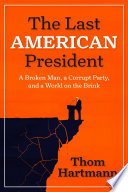
The Last American President
Thom Hartmann
From bestselling progressive talk show host Thom Hartmann comes an urgent autopsy of American democracy, showing how plutocrats, political cowardice, and systemic rot built the perfect runway for Trump's authoritarian ascent. The Last American President rips open America's wounded democracy to expose a terrifying truth: Donald Trump isn't an anomaly—he's the inevitable product of a system engineered to fail. This searing investigation reveals how a man forged by childhood trauma, pathological narcissism, and calculated cruelty didn't hijack democracy—he was handed the keys by those who should have been its guardians. Hartmann uncovers the unholy alliance between Trump's damaged psyche and America's rotted institutions. From Fred Trump's brutal parenting to Roy Cohn's lessons in shamelessness, from a Republican Party that traded principles for power to billionaire donors who treated democracy as a profit center, this book exposes the assembly line that manufactured an authoritarian. But this is about more than Trump's past—it's about America's future. As climate catastrophe accelerates and fascism spreads globally, Hartmann reveals the nightmare scenario: a second Trump term that doesn't just end American democracy but also triggers irreversible planetary damage. Through meticulous research and unflinching analysis, he shows how political cowardice and corporate greed created the perfect storm that could extinguish humanity's last chance at survival. This isn't just political commentary—it's a last-minute alarm sounding before the point of no return.
show more
The Nonviolence Handbook
Michael N. Nagler
“Nonviolence is not the recourse of the weak but actually calls for an uncommon kind of strength; it is not a refraining from something but the engaging of a positive force,” renowned peace activist Michael Nagler writes. Here he offers a step-by-step guide to creatively using nonviolence to confront any problem and to build change movements capable of restructuring the very bedrock of society. Nagler identifies some specific tactical mistakes made by unsuccessful nonviolent actions such as the Tiananmen Square demonstrations and the Occupy protests and includes stories of successful nonviolent resistance from around the world, including an example from Nazi Germany. And he shows that nonviolence is more than a tactic—it is a way of living that will enrich every area of our lives.
show more
Racial Justice at Work
Mary-Frances Winters and The Winters Group Team
Creating justice-centered organizations is the next frontier in DEI. This book shows how to go beyond compliance to address harm, share power, and create equity. Traditional DEI work has not succeeded at dismantling systems that perpetuate harm and exclude BIPOC groups. Proponents of DEI have put too much focus on HR solutions, such as increasing representation, and not enough emphasis on changing the deeper organizational systems that perpetuate inequities-in other words, on justice. DEIJ work diverges from traditional metrics-driven DEI work and requires a new approach to effectively dismantle power structures. This thought-provoking, solutions-oriented book offers strategic advice on how to adopt a justice mindset, anticipate and address resistance, shift power dynamics, and create a psychologically safe organizational culture. Individual chapters provide pragmatic how-to guides to implementing justice-centered practices in recruitment and hiring, data collection and analysis, learning and development, marketing and advertising, procurement, philanthropy, and more. DEIJ pioneer Mary-Frances Winters and her coauthors address some of the most significant aspects of adding a justice focus to diversity work, showing how to create a workplace culture where equity is not a checklist of performative actions but a lived reality.
show more
Reclaiming Your Community
Majora Carter
Majora Carter shows how brain drain cripples low-status communities and maps out a development strategy focused on talent retention to help them break out of economic stagnation. "My musical, In the Heights, explores issues of community, gentrification, identity and home, and the question: Are happy endings only ones that involve getting out of your neighborhood to achieve your dreams? In her refreshing new book, Majora Carter writes about these issues with great insight and clarity, asking us to re-examine our notions of what community development is and how we invest in the futures of our hometowns. This is an exciting conversation worth joining.” —Lin-Manuel Miranda How can we solve the problem of persistent poverty in low-status communities? Majora Carter argues that these areas need a talent-retention strategy, just like the ones companies have. Retaining homegrown talent is a critical part of creating a strong local economy that can resist gentrification. But too many people born in low-status communities measure their success by how far away from them they can get. Carter, who could have been one of them, returned to the South Bronx and devised a development strategy rooted in the conviction that these communities have the resources within themselves to succeed. She advocates measures such as • Building mixed-income instead of exclusively low-income housing to create a diverse and robust economic ecosystem • Showing homeowners how to maximize the long-term value of their property so they won't succumb to quick-cash offers from speculators • Keeping people and dollars in the community by developing vibrant “third spaces”—restaurants, bookstores, and places like Carter's own Boogie Down Grind Cafe This is a profoundly personal book. Carter writes about her brother's murder, how turning a local dumping ground into an award-winning park opened her eyes to the hidden potential in her community, her struggles as a woman of color confronting the “male and pale” real estate and nonprofit establishments, and much more. It is a powerful rethinking of poverty, economic development, and the meaning of success.
show more
Rise and Resist
Janice Gassam Asare, PhD
Fiery. Evocative. Uplifting. Fiction meets reality in these impassioned and hard-hitting essays on love, courage, politics and resistance. The words are a rallying cry, a balm to the soul, and fuel or the fire of social change that ignited a revolutionary movement in a fictional United States "just around the corner of today".
show more
Wealth Supremacy
Marjorie Kelly
This powerful analysis explains how the bias toward wealth that is woven into the very fabric of American capitalism is damaging people, the economy, and the planet and explores what the foundations of a new economy could be. This bold manifesto exposes seven myths underlying wealth supremacy—the bias that institutionalizes infinite extraction of wealth by and for the wealthy and is the hidden force behind economic injustice, the climate crisis, and so many other problems of our day: The Myth of Maximizing—No amount of wealth is ever enough. The Myth of Fiduciary Duty—Corporate managers' most sacred duty is to expand capital. The Myth of Corporate Governance—Corporate membership must be reserved for capital alone. The Myth of the Income Statement—Income to capital must always be increased, while income to labor must always be decreased. The Myth of Materiality—Profit—that is, material gain-alone is real, while social and environmental damages are not. The Myth of Takings—The first duty of government must be the protection of private property. The Myth of the Free Market—There should be no limits on the sphere of influence of corporations and capital. Kelly argues instead for the democratization of ownership: public ownership of vital services, worker-owned businesses, and more. And she sketches the outlines of a nonextractive capitalism that would be subordinate to the public interest. This is an ambitious reimagining of the very foundations of our economy and society.
show more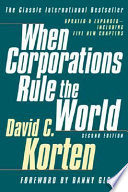
When Corporations Rule the World
David C. Korten
When Corporations Rule the World has become a modern classic. Korten's warnings about the growing global power of multinational corporations seem prophetic today. This new edition has been revised throughout to make it more accessible to the general reader, and features a new introduction, a new epilogue, and three new chapters. While Korten points out that the multinationals are, if anything, more powerful now than they were when he first wrote the book, he also offers reason for hope: the growth of the international Living Democracy movement opposing corporate rule. The new material in the book: * Documents the consolidation--since1995--of financial and corporate power at the expense of democracy, people, communities, and the planet * Looks in depth at the nature and cultural underpinnings of the burgeoning Living Democracy movement to resist corporate power * Offers a vision of a what a "civil society"--grounded in life-centered values rather than immediate financial gain--might look like.
show moreWho Do We Choose To Be?
Margaret J. Wheatley
Written from the author's desire to summon us to be leaders for this time as things fall apart, this book explains the need to reclaim leadership as a noble profession that creates possibility and humaneness in the midst of increasing fear and turmoil. -- Edited summary from book.
show more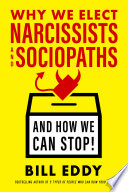
Why We Elect Narcissists and Sociopaths-and How We Can Stop!
Bill Eddy
Bestselling author, therapist, lawyer, and mediator Bill Eddy describes how dangerous, high-conflict personalities have gained power in governments worldwide—and what citizens can do to keep these people out of office. Democracy is under siege. The reason isn't politics but personalities: too many countries have come under the sway of high-conflict people (HCPs) who have become politicians. Most of these high-conflict politicians have traits of narcissistic personality disorder, antisocial (i.e., sociopathic) personality disorder, or both. This is the first and only guide for identifying and thwarting them. HCPs don't avoid conflict, they thrive on it, widening social divisions and exacerbating international tensions. Eddy, the world's leading authority on high-conflict personalities, explains why they're so seductive and describes the telltale traits that define HCPs—he even includes a helpful list of forty typical HCP behaviors. Drawing on historical examples from Hitler, Stalin, Mao, and Nixon to Trump, Maduro, and Putin, Eddy shows how HCPs invent enemies and manufacture phony crises so they can portray themselves as the sole heroic figure who can deal with them, despite their inability to actually solve problems. He describes the best ways to expose HCPs as the charlatans they are, reply to their empty and misleading promises, and find genuine leaders to support. Eddy brings his deep psychotherapeutic experience to bear on a previously unidentified phenomena that presents a real threat to the world.
show more